| |
| |
Imitation goods and services in Ireland
| |
ca. 2012, Republic of Ireland —
 | |
Many goods and services on the Irish market are a mere facsimile, minimally applicable to the intended purpose if at all.
• I bought a case of "Challenge" brand drill-bits from Argos, and on first inspection it was clear that the mortar bits were not made of hard steel, and that they didn't even have a sharp edge. But I needed to put a few holes into a concrete wall, so I decided to try. The bit that I selected could hardly make a dent, and certainly could not drill. Insistent, I set up a chair in order to stand in the best position for applying heavy pressure. The drill-bit fell apart, splitting into a double helix.
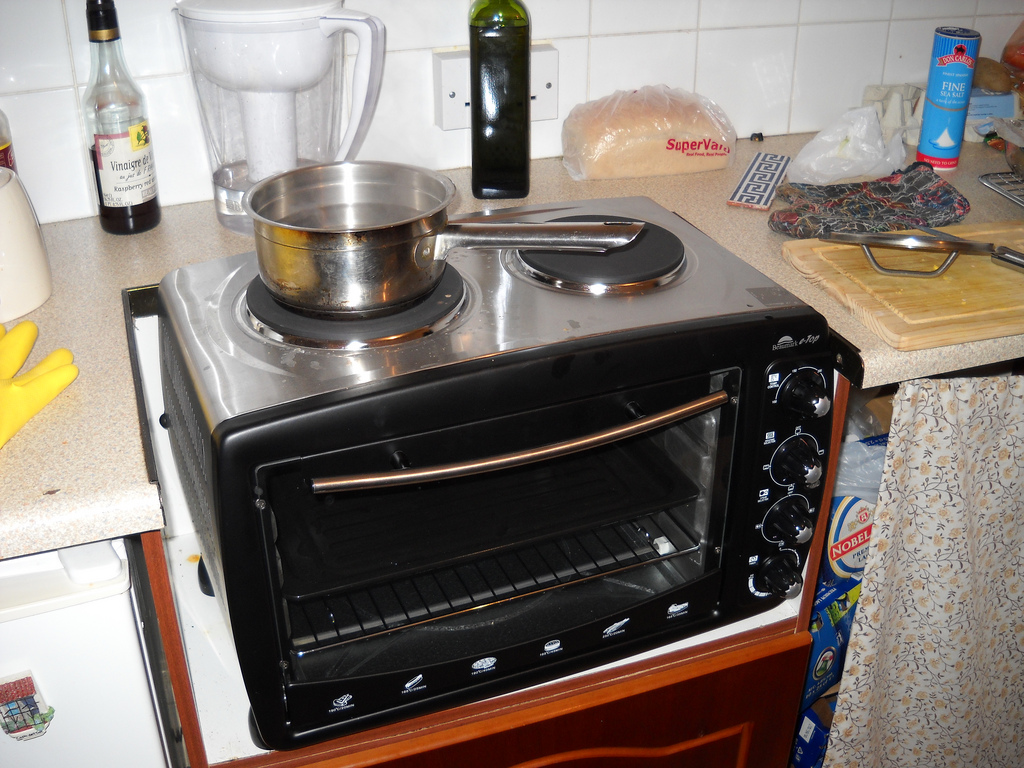
• A landlord in Cork city replaced a small old poorly-functioning oven/stovetop unit with a new one that wasn't even designed for workability. The "Beaumark e-Top BM468" had one control-knob for its two stove-top surfaces. This one switch would allow the user to operate either the large, the small, or both hobs — on or off. I tried to use it. It wouldn't cook a decent meal. I wondered how long it would take to boil a pot of water on the largest hob (supposedly 1000 watts.) After one hour, I stopped the experiment. The landlord quickly replaced the unit, I should say, in fairness to him.
• Irish talk-radio is often excellent. Irish music radio, however, is exceptionally bad. All mainstream Irish radio stations play almost only the same tiny list of songs over, and over, and over again. They also play a lot of cheap re-makes of songs that were popular in other English-speaking countries two or three decades ago. Manufactured bands, too, are big. A lot of what Irish radio stations play is not real music — it's just a facsimile that fits the superficial purpose that music serves, for people who don't really listen to it.
| |
"It's on our website," said one customer-service telephone-answering employee.
The information was not on the website — neither on the home page nor on the broadband-services sales-page. So even assuming that a customer would have any reason to visit his or her ISP's website, where "the information is available," the information was not available.
The fact that some of the goods and services here are even legally on the market is astounding.
The Irish people are not normally willing to complain. They'd generally be unlikely to raise any kind of a formal grievance if they can avoid it.
It's factored into the business culture....
| |
| Comment |