| |
| |
Flash-dryer modified for water-based printing on fabric in a tight workspace
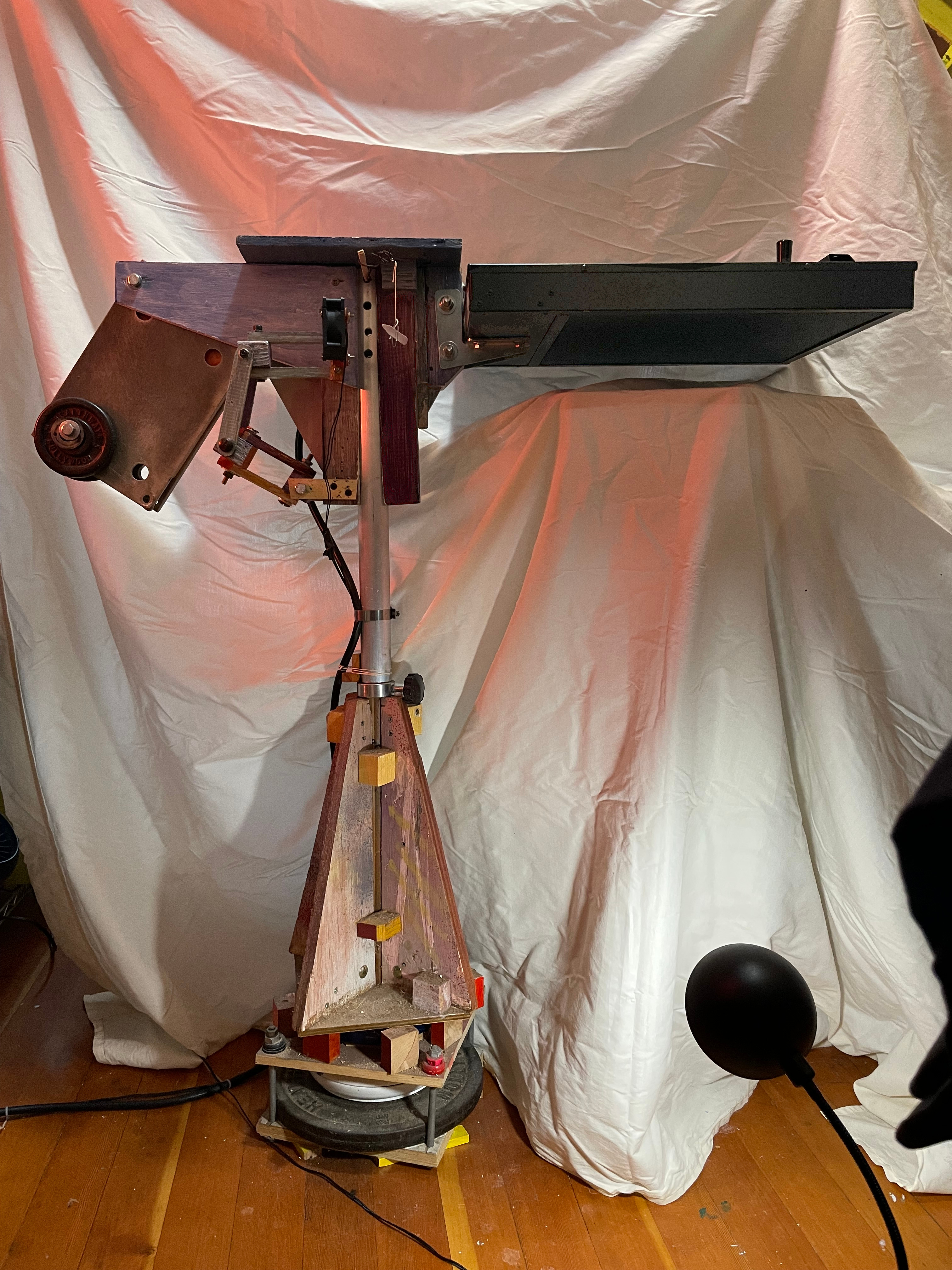
I bought a "flash-cure" unit that needed some innovations to suit my tiny screen-printing shop.
As delivered, it had 4 legs on casters that were in footspace. Cursory search online: that's a common problem. And I'm working in a tiny residential bedroom. I had a heavy base that I had attached with a sturdy vertical axle. I would need a counter-weight to keep the device in balance.
I was unable to calculate the mathematics of a counterweight - the necessary mass and length of an armature as counterbalance to the weight and reach of the cure unit. So I had to experiment.
The heating element didn't swivel far enough into the work from a stationary position so I added 4 inches to the reach, adjusting the counter-weight accordingly. (I added more.)
I made a double-jointed arm so I could adjust the reach of the counter-weight, and its leverage. This worked, but it was not durable. It cracked, but it had served the purpose of establishing the length. I made a stronger armature based on what I had learned.
The base itself rotates but that's not necessary. As factory-shipped, the upper tube simply turns on an adjustable collar on the lower tube. This is not entirely true, because sometimes for whatever reasons the resting positions shift and a manual adjustment of the base swivel fixes it. That's a ceiling-fan motor under there, of course. Mounts flat, strong vertical axis.
The small articulated armature holds a PC fan for pushing air across the work surface, replacing water-laden air with dry.
The goal of the flash cure unit is to cure the piece enough that you can keep working with it. "Cure" is a misnomer, especially with water-based inks. The flash cure unit is not best suited for a full cure, although it can do the job if you're careful and lucky and keep learning.